Sunny Pathway

Tuesday, July 22, 2008

Developing Deep Roots

I have a friend who received life-changing insight—a revelation, if you will. I’d like to share it.

Not many excitedly quote verses like James 1:2,3: Count it pure joy, my brothers, whenever you face trials of many kinds, because you know that the testing of your faith develops endurance. (NIV) Personally, I don’t want to take those verses seriously. Although I understand physical exercise increases endurance—no pain, no gain—I don’t generally apply it to my emotional or spiritual well-being .

My friend looks at it differently since she had the revelation. She remembers her childhood as almost idyllic, free of stress. Reared as an only child by parents who were almost elderly and financially established, she went on to marry a loving husband and had three beautiful children. Although there were financial hurdles in the beginning, they did well financially, too. Yet, for no apparent reason, she struggled with depression as a young mother. Even after dramatic changes during a crisis when she met Jesus, she continued over the years—and continues today—to struggle with what she calls squirrely thinking.

Now retired, she and her husband spend part of each year in Arizona. On a balmy Arizona-winter day, they went to see what had been developed as a Bio Sphere not far from Tucson. You may recall this was an isolated area—complete with shields to separate and protect from the outside environment—that had functioned as an experiment with a controlled environment. Today it's part of the University of Arizona and a major tourist attraction.

While her husband walked the grounds, she decided to rest by watching videos about the experiment. Something caught her interest—she learned the trees in the protected environment did not grow large. After reaching a certain height, they simply fell over.

Scientists eventually concluded that lack of wind and other stress-inducing factors affected the tree’s development. They didn’t grow a strong base or foundation because it was not needed in their environment. They didn’t grow strong roots.

And my friend had an epiphany. Was her emotional vulnerability caused by lack of stress during her childhood? Did the idyllic world she experienced as a youth fail to prepare her for life? Did she lack a strong emotional root system because she hadn’t needed to develop strength? In the quietness of her heart she felt God said it was so.

This generates a number of philosophical questions. For my friend, however, it offered understanding of her past and practical wisdom for the present and future. She realized that during her difficulties as an adult she had been growing the deep roots she needed. Rather than lamenting her emotional weaknesses, she saw God was working with her and in her. She embraced difficulties as part of her development into a woman of faith and endurance.

I can’t escape the implications of her story. Her insight became my insight. My childhood may not have been idyllic, but God was with me. If it had been different, I would be different. I can’t shake the conviction that God not only made me, but He’s continued to shape me throughout my marriage and during the years of raising our family. He’s even shaping me today as I accept life as a Senior. He embraces me with my embarrassing imperfections because that’s the way I interact with the life He’s given me. I don’t understand much of what happens, but I do know in all things God works for good of those who love him, . . . (Rom. 8:28 KJV) It’s enough to keep me going. I might even be able to count it joy!

Tuesday, July 15, 2008

The Cage

A friend complained about a temporary foot problem: Before this happened, she said, I didn’t even know I had feet. They’ve never bothered me.

Oh, to be able to forget about feet. A luxury beyond imagination.

I was born with a fairly common congenital condition that is problematic by itself. When I began struggling with rheumatoid arthritis, my feet became a constant source of pain. If you saw me walk down the street today, you wouldn’t know I had a problem, but that hasn’t always been the case. In this post I’m going to tell you about a simple device that made a huge difference—and that might help others as well.

At one point I couldn’t tolerate anything on my feet when in bed—not even the weight of blankets. I read an article in an arthritis magazine that suggested placing a board below the feet to keep the blankets off. The board fell over the first night. In the morning the board was too heavy for me to handle when I wanted to make the bed.

A nurse suggested pillows and they were better—but not great. At best, they took a lot of space. If I moved too much and they began to topple, they’d spread out over the entire bottom of the bed. After a month or two with that scenario, my husband Ken had enough and came up with his solution. We called it The Cage:


The first cage had another bar along the bottom of the back. That held it in place when under the blankets. And it worked. I’m grateful to God for answered prayer and I'm grateful for doctors and the medications, but I can’t imagine how I’d have made it without my cage. In winter I added a hot water bottle to keep my feet toasty warm all night.

Nurses who looked at the cage called it a foot cradle. However, foot cradles in catalogs are different—devices that slide under the mattress and that interfere with making a bed. I wouldn’t be able to handle them by myself. They’re probably fine for people who are bedridden, but I wanted a normal life and that included a normal bedroom.

If we stayed overnight with someone, I carried the cage with me as though it was an extra piece of luggage—it made a great conversation starter. As long as we traveled by car, no problem; but not so when flying. Although lightweight, the cage was too bulky to pack. So when we decided it would be cheaper to fly to visit our daughter and family, Ken made adjustments. He removed the long bottom piece (the one missing in the photo) and put hinges where the sides met the top so they could fold in. To reattach the bottom he installed small hooks. When unassembled and folded, it fit in a suitcase.

It worked well for a time, until the eyes for the hooks loosened. Then the hooks would occasionally come free, the back piece would slide out of place, one or both of the side pieces would slide in, and I’d feel not only blankets but wood pieces on my tender feet.

As a temporary measure Ken reassembled the sides permanently, forgetting about the back piece. This didn’t stay in place as well but my feet were much better and we got along.


Until Ken made the latest improvement—a cage out of PVC pipe.

It looks complicated because the corners don’t quite meet. That’s one reason I wanted to show the wood version first, to provide a clear illustration of function. In this cage the pieces are joined by various kinds of elbows that have to be placed according to availability.


The PVC cage is better on several counts:

1. It’s easy to assemble and disassemble. Joints of the top and bottom rectangles are glued together, but the four vertical pieces are easily removed. They don’t come apart in bed because the weight of the blankets keep them in place.
On a daily basis I leave it intact; it rests on the floor of my closet. When we pack for a trip, even if it’s a trip by car, I take it apart, pack it, and assemble it again when I unpack.


2. PVC is lighter than wood. Although the pieces Ken used for the wood version were not heavy, this weighs almost nothing.

3. The edges are round. With the original cage, even Ken would occasionally kick the sharp edge of the wood pieces during the night. PVC pipes are less intrusive.

4. PVC pipes are inexpensive and easy to cut with a saw.

There is a down side. Our bottom sheet wears out more quickly in the spots where the corner of the cage rests. This was true of both versions. We think it’s a small price to pay—well, with today’s prices, a not-so-small price—but nevertheless, a price we’re willing to pay for the benefits gained. Here’s a picture of the cage under our bedding.


If tender feet are a problem for you, try making a cage. You’ll like it.

Wednesday, July 9, 2008

Establishing Solid Bases

As he scraped ice near the front door last spring, one of the men in our condo building didn’t like the hollow sound he created. He also noticed cracks. After some discussion the condo board consulted an expert, the men living in the building took a walk around the premises where they found additional incriminating evidence, and all agreed repairs were necessary. Recently, two monstrous trucks and a group of workmen finally arrived. They drilled holes the size of a quarter in key locations and forced sand under the concrete through the holes to provide a solid base. The estimated price tag was hefty.

From my perspective, the entire event was mind-boggling. Concrete is always poured on solid ground—it can’t hang in mid-air. Apparently the ground settled, shifted, after it was poured and the concrete was held up only by its connections around the edges. When the men saw what needed to be done and took care of it, they demonstrated a Biblical truth. The Apostle Paul said, There are different kinds of gifts, . . . ( I Cor. 12:4 NIV) People are instructed to recognize each other’s giftings and work together. I’m so proud of them. Because the cracks are no longer problematic, our front door remains pleasant, welcoming.


That’s my reflection—I’d have dressed up if I’d known I’d be visible. You can also see a portion of the high school athletic field across the street.

When the trucks and workmen drove away, my husband Ken was left with the bill. (He’s gifted in the area of keeping records so he serves as treasure.) He looked at me and asked if I’d ever think to check for support under the concrete. The idea struck me as ludicrous—it wouldn’t enter my mind. He commented, We’d have let it settle until we had huge cracks and then had to replace the whole thing.

Instead, when we surveyed the completed project, we saw that not only are two areas with cracks level, but the concrete drive is level with the garage aprons. And none of the concrete sounds hollow.


Settling or shifting bases aren’t limited to concrete. In fact, several of my bases have shifted in recent years:

1. I’ve gone through major relationship changes—key people I depended on are no longer available.
2. I realized an institution was not what I thought it was.
3. Ken and I have made two major moves since retirement, each requiring adjustments.
4. Some of my ideas haven’t stood the test of time, either—things I thought rock-solid turned mushy.

No wonder friends say, Aging isn’t for sissies. To make matters worse, I understand that although adjusting can become harder with age, it also becomes more important.

This leads me to a second Biblical truth: God is my base, my support. Before He ascended into heaven, Jesus told Peter, “when you were younger you dressed yourself and went where you wanted; but when you are old you will stretch out your hands, and someone else will dress you and lead you where you do not want to go.” (Jn. 21:18 NIV)

Could Peter have adjusted to the travel, ministry, and finally, the up-side-down crucifixion that made up his future without God as His ultimate support? He wrote, Though you have not seen him, you love him; and even though you do not see him now, you believe in him and are filled with an inexpressible and glorious joy, . . (I Pet. 1:8,9 NIV)

God outlasts people, institutions, locations, ideas. He also brings in new people, institutions, locations, ideas. I know it sounds simplistic, but when I quiet my heart, He’s available. This has been the testimony of Christians throughout the ages, whatever their circumstances.

As for our condo, would you believe that addressing the problem early meant everything went well and the company we hired cut the bill by just over 25%?

I praise God because the cost was lower than anticipated. I praise God because the men in our condo were able to work together. And I praise God because He is my base, the One who holds me up when my the rest of my world begins to shift.

Wednesday, July 2, 2008

RSS Feeds

From time to time I plan to include helpful information in this blog. That could mean writing about someone’s experience with a specific piece of health equipment—such as the Roll-A-Bout I used after surgery on my foot. Or, sharing thoughts on the advantages of an electric bottle opener. Or, tips designed to make life easier.

Because this post coincides with telling family and friends about my blogs, I’m providing info on RSS feeds found in some internet sites. This will be almost identical to the info I included in the email many of you received. Offering it as a post in a blog means it will be archived and available for future reference.

I wondered about RSS feeds for over a year. A week ago Ken figured out how to make my blogs available through RSS feeds. Then he learned how I can access other feeds and they do make life easier.

Advantages of RSS feeds: They send the material to you; you don’t have check to see if there’s something for you. Installing a reader seemed like insurmountable hurdle to me, but I learned it’s a simple procedure—I’m already using it to receive other mail. (RSS actually stands for Really Simple Syndication.)

To Subscribe: Click on Subscribe to--Post. If you wish to subscribe to comments, click that button as well. A drop box will display the names of several possible Readers. If you already have a reader, you will know what to do. I didn’t, so I selected Google—but any brand is fine. After selecting a reader, I clicked and followed the instructions provided. From that point on, requested postings are sent whenever they are posted. Although the visible indication of an RSS feed might vary from site to site, this technique works with all RSS feeds. For me, the key was installing the reader.

Tuesday, June 24, 2008

Enjoying God's Creation

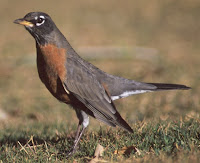
We live in an urban setting. A few days ago a young robin visited our deck. We were thrilled because we haven’t co-habited with robins on a regular basis for awhile. When we lived at the lake, our habitat was too wild for them.

Birds were one of the big draws of the lake. Red-winged blackbirds were our harbinger of spring. Their beauty can’t be denied in the wild—even if they do swagger.

By the time summer arrived in earnest, there were almost too many birds to list. Yellow warblers lived in a thicket on our lot and we enjoyed their unusual flight patterns, flitting back and forth somewhat like a butterfly—or a yellow leaf floating in the breeze.


Goldfinches flew in straight lines, whizzing by like an arrow or bullet. They lived in Mud Lake, on the other side of the road, but we still heard them sing.


Nuthatches walked down a tree-trunk upside down.

Chickadees stayed all year.

Neighbors didn’t want woodpeckers because they might destroy property by pecking on it. All the same, we reveled in the bird’s cunning. Of the several varieties, the pileated woodpecker was most spectacular. We spotted a male through our windows—he hid on the other side of the trees when we were outdoors.


Loons were Ken’s favorite. Their haunting call brings magic to a summer’s eve. A mother loon carries her babies on her back—barely above the water level.


We had large birds, too. Pelicans circles above the center of the lake, looking for dinner.

A Great Horned Own visited just once.


Bald eagles nested nearby. Solitary adults floated by looking for sustenance, but once a group of three nestlings surveyed the area as a group before embarking on their independent life.


A great blue heron occasionally rested on our dock, usually leaving large droppings. We discouraged Canadian Geese because their droppings weren’t an easy clean on the dock but a messy pile in the grass.

Seagulls were a constant.


But the small birds our elicited our smiles. One summer a pair of bluebirds nested nearby. The male sat on our deck railing for almost five minutes one sunny afternoon. A pair of Orioles graced us with their presence our last summer at the lake. We didn’t see them often, but a brilliant orange blur streaking across the yard was good for an adrenalin rush. I’ve wondered if they came back again.

Moving to town—into a condo in an area of new construction—meant bird-withdrawal. Our only birds the first summer were some sort of swallow, unwelcome although still attractive. I understood the rationale, but I briefly mourned when our fellow condo-dwellers sprayed water to remove the nests from our building.

The next summer we noticed partridges. Well, we initially called them quails and then prairie chickens, both of which do not fit the pictures in the bird book. They're a prairie bird, hard to spot unless moving, but they know how to run—like a toddler with a new-found skill. They fly only at low elevations.


Last year a rather large bird swooped toward my husband on the deck and bumped into the wall. When it fell stunned to the floor, Ken identified it as some sort of falcon. We decided to call an authority in the morning. At 7:15 a.m. the bird was huddling in the corner. By 8:00 a.m . it was gone.


We’ve been here five years now. Trees are getting larger and grass is established. Last summer, a few robins discovered us. This summer I hear them singing much of the day. The enjoyment they bring is immense.


They sing their song:

Don’t despair. It’s going to be okay. God is in control.

Wednesday, June 18, 2008

Adding Pictures

There will no doubt be many things to learn about blogging that I didn’t think of before I started. After posting last week I decided entries should be shorter, that each entry needed more white space (space not filled with text, whatever the background color), and that graphics or pictures would add interest. None of these things come naturally for me. I’ve never been the picture-taker—I dislike technical details and machines while Ken was a photographer in the navy. He's always taken the pictures, but now I’m motivated to learn.


I plan to expand my efforts later to focus on people (with expressions!) and the great outdoors, but I started by focusing on our living area where nothing moves. I’m inserted them in last week’s post—to make it visually interesting.


Nothing is simple. First pictures are loaded from the camera into the computer—Ken said he would help me with that for a season. Then they're moved from computer files into the blog, a complicated procedure I'm learning. I'm trying to accept this as a challenge to keep my mind active, supple, and young. I think it's working because my brain hurts as I forge new connections between my brain cells. By the time I've learned how to handle it, my IQ will be 5 points higher.


Because I thought this week's blog also needed visual interest, I looked through pictures still in the camera to find one I didn’t think I'd use later. The camels below qualified and I think they’re amazing. I asked Ken to take the picture in Abu Dhabi, United Arab Emirates, a little over a year ago when we visited our oldest son and his family who live there. Can you relate to painted animals? In North Dakota we have painted bison in Fargo and painted horses in Minot. Someone told me a city on the West Coast features painted pigs. Do you also think the possibilities of an epidemic are a little bit frightening? But the Arabs know what Americans think is cool—so why shouldn’t Abu Dhabi have painted camels? Then again, maybe they started it and we copied the idea from them.


Friday, June 13, 2008

Discovering My Passions

After our youngest daughter helped with my blog designs, I thought the major hurdle in creating blogs was over. I didn’t take my limited computer skills into account. Would you believe my husband figured out that our system wasn’t communicating with another system? And he not only figured it out, but he took steps to fix it!

Yesterday he checked both blogs and discovered each had a comment—one from someone I couldn’t identify. That posed a problem. The initial postings were like tests, and I didn’t want to write more until everything was in order. Now I shall have to begin in earnest.

Would it shock you to hear that the hardest aspect of growing older for me has been learning to live with myself. That includes both positive and negative aspects of myself.

First, a word about the negative. When I was younger—not in the early motherhood stages but later, when the children were gone or almost gone—I didn’t take the time to deal with life’s issues—I stuffed them. My advice to those in their 40s and 50s? Deal with issues because, if you don’t, they will eventually cave in on you. Maybe I’ll write about them later—occasionally—one at a time.

Dealing with positive truth can prove challenging, too. When I began dealing with the hurts and failures of my past, I experienced a positive truth I didn’t know I needed. I learned my personality was perfect.

During a difficult season, when we were in the process of building a lake home and when I had serious health problems, I dragged myself into the unfinished great room to make dinner. As I rounded a corner, God spoke to my heart. I didn’t hear audible words. I’d been struggling with many things and God’s voice quietly addressed them. Deep within, I knew God made me the way He wanted me and that He loved my personality.

Even now, almost ten years later, when I key those words into the computer, I feel overwhelmed--in part because I think people will be offended, but also because I believe He actually feels that way. After gradually experiencing the differences this truth has made in my life, I accept the revelation as a cornerstone of my identity. He made me, and He made me perfect. My problems didn’t—don’t—stem from a faulty personality. Real problems stem from lack of character. As for personality, every person is a unique reflection of Him and He wants to enjoy us. Wow.

I've included this picture of different shapes. I'm so glad God gives us variety throughout every aspect of life.


The initial effects of the revelation were subtle. The first noticeable change was the way I argued with Ken. Building a house is stressful and we had to make daily decisions. I learned to compromise.

It affected my relationships with others, too. I no longer felt a need to assert myself as I had. Because I experienced God’s approval, I didn’t actively seek it from outside sources—at least not as diligently.

But who was I? Who was this personality God loved?

I’ll just focus on a few passions because I believe they define a person. The first, of course, is God Himself. I could focus on finding my identity in Him. But I don’t believe that was His point when He spoke to me.

The second is my family. Ken and our children plus their children are my major earthly passion. But I felt impressed to focus on passions which motivate and move me regardless of family or any other influence. Passions intrinsic to my nature.

I am passionate about color. Especially red—but also yellow. Then you can add the brights—bright green, bright blue, bright purple. I don’t believe preferring bright colors is virtuous. I purchased a red wool sweater for Ken a few years ago at a ridiculous close-out price. But like so many married couples, Ken and I have different personalities. When he tried it on he said, It’s so red. He stuck to his grays and blues. The secret is that Ken’s personality is perfect, too. God loves variety and we all reflect, in part, His infinite nature.

I've included a picture of our red and yellow walls in the corner where they meet. The yellow is brighter in real color.


On a negative note, pun not intended but acknowledged, I am not passionate about music. I have a good ear and a nice voice, so I’ve felt guilty about not developing this gift. I suspect something happened early in life that caused me to withdraw from musical expression. I enjoy it and the people who love it greatly, but unless God heals, or motivates, or gives it to me as a passion—I’ll let it go. The Bible tells me, there is now no condemnation for those who are in Christ Jesus, because through Christ Jesus the law of the Spirit of life set me free from the law of sin and death. (Rom. 1:8 NKV)

I am passionate about writing. These days I feel compelled to express myself with words. But writing isn’t a virtue, either. I suspect I didn’t follow my inclinations to write when I was young because I was afraid I wouldn’t be good enough. Today I feel no pressure to write brilliantly. I think about writing creatively and I focus on stating ideas clearly; it brings great joy. The pleasure is in the doing—because God made me that way.

Other passions? Reading and road trips. And at a reduced level, fashion and decorating (even on a limited budget), swimming, enjoying the outdoors, relaxing in the sun. I loved camping when we were younger, but now Ken and I worry about getting up from our air mattresses so I feel somewhat deprived at times.

Pursuing passions is challenging because it generates change—doing things like creating blogs. Change can be stressful but it’s exciting. For reasons I can’t explain, I’ve concluded God enjoys these things more than I—even fashion when properly done and emphasized. He created people with the capacity to create and to enjoy their creations—because He is creative and He enjoys His creation. He enjoys our creative process because it’s an extension of His creative process. That’s the nature of our God.